
The First 30 Days
Belong to Us
When a disaster hits Kaʻū, help from the State and Federal government is coming. It is simply not coming right away. Mālama Kaʻū Foundation exists to hold that gap, moving urgent supplies to the most vulnerable residents of our district in the window between impact and the arrival of large scale relief.
Our 3rd NHO giveback effort, alongside dialysis and the Kaʻū High School field lights.
The highway closes, power drops, water goes off line, and Kaʻū is on its own.
Assess the district, reach kūpuna households first, and deliver urgent items directly, hand to hand.
State and Federal programs reach full stride, and our work shifts to complementing them.
The most critical window is the one before the convoys arrive
Large relief operations are built for scale, and scale takes time. Damage has to be assessed, disaster declarations have to move through the State and then the Federal system, and staging areas have to be established before trucks roll. For a rural district at the end of a single road, that process reliably runs about a month.
The people who suffer most in that month are the ones with the least margin. Kūpuna living alone. Households on fixed incomes. Families with no vehicle, no generator, and no way to drive three hours round trip for water and propane. Our mission is to reach those residents in days rather than weeks, and to hand the larger effort a district that has already been assessed by people who live in it.
This is not a substitute for government support. It is the bridge to it.
Kaʻū is not Oʻahu
Relief plans written for an urban island do not work here. Kaʻū covers more ground than the entire island of Oʻahu while holding a fraction of one percent of its population, and there is one way in.
We are from Kaʻū, and Kaʻū knows us
Our leadership was born and raised here, ten generations deep in this district. We know which roads wash out first and which ones hold. We know the four wheel drive tracks behind the cane haul roads, the ranch gates, the subdivisions with no addresses, and the houses at the end of them. We know which kūpuna live alone and which ones will never call for help even when they need it.
That knowledge is what turns a truckload of supplies into supplies actually delivered. An outside organization arriving with the best intentions still has to learn the terrain, find the people, and earn the trust. We start with all three.
Trust is the part that cannot be shipped in. Our neighbors know who we are and what we stand for, because we are still here between disasters, working on dialysis capability at Kaʻū Hospital, on the field lights at Kaʻū High School, and on jobs that let families stay in this district. When we knock on the door, the door opens.
What Hurricane Lala taught us
Kaʻū was the hardest hit district in the state. Everything we learned in that response is built into how we will run the next one.
Assess first, and assess locally. An accurate district wide picture in the first days determines whether supplies reach the right households or pile up at the wrong end of the highway.
Kūpuna households come first. Age, isolation, and medical need set the delivery order, not proximity to the staging area.
Plan for no power, no water, and no signal. Requests arrive by word of mouth when cellular is degraded, so intake has to work on paper, by radio, and by phone as well as online.
Standardize the kit. Water, propane, lighters, non perishable food, ice and coolers, batteries, hygiene and cleaning supplies, moved as a repeatable package instead of assembled one run at a time.
Move on our own logistics. Waiting for a distribution point to be established somewhere else costs days that vulnerable residents do not have.
Account for every dollar. As a 501(c)(3) we publish our IRS returns annually, including board compensation, so donors can see exactly where relief funding went.
Local knowledge, global logistics
Knowing the ground is only half of it. Reaching the whole district for thirty days takes supply chains and coordination that no small foundation builds alone, so we brought in partners who do this at scale.
Global relief and supply chain partner
We have partnered with one of the largest international disaster relief and logistics corporations in the world, headquartered in Dubai, with the sourcing, kitting, and transport capability to stand up thirty day isolation kits sized for Kaʻū households.
State of Hawaiʻi emergency response
We coordinate with the State's emergency management structure so our early relief lines up with the larger operation instead of duplicating or complicating it.
County of Hawaiʻi emergency response
We work directly with the County's emergency response team and the Mayor's office, sharing what we see on the ground in Kaʻū as we see it.
Kaʻū community leaders
Pāhala, Nāʻālehu, Ocean View, and the homesteads in between each have their own leaders and networks. They tell us who needs what, and they open doors we could never knock on alone.
Readiness
Hand to hand, door to door
Supplies bought, loaded, hauled down the highway, and put directly into the hands of Kaʻū residents by people from Kaʻū.
8/25/2026. Delivering .donations to Pahala Community Center
8/25/2026. Donating pallets of bottled water to Na'alehu residents.
8/26/2026. Delivering non-perishable food to locals impacred by storm.
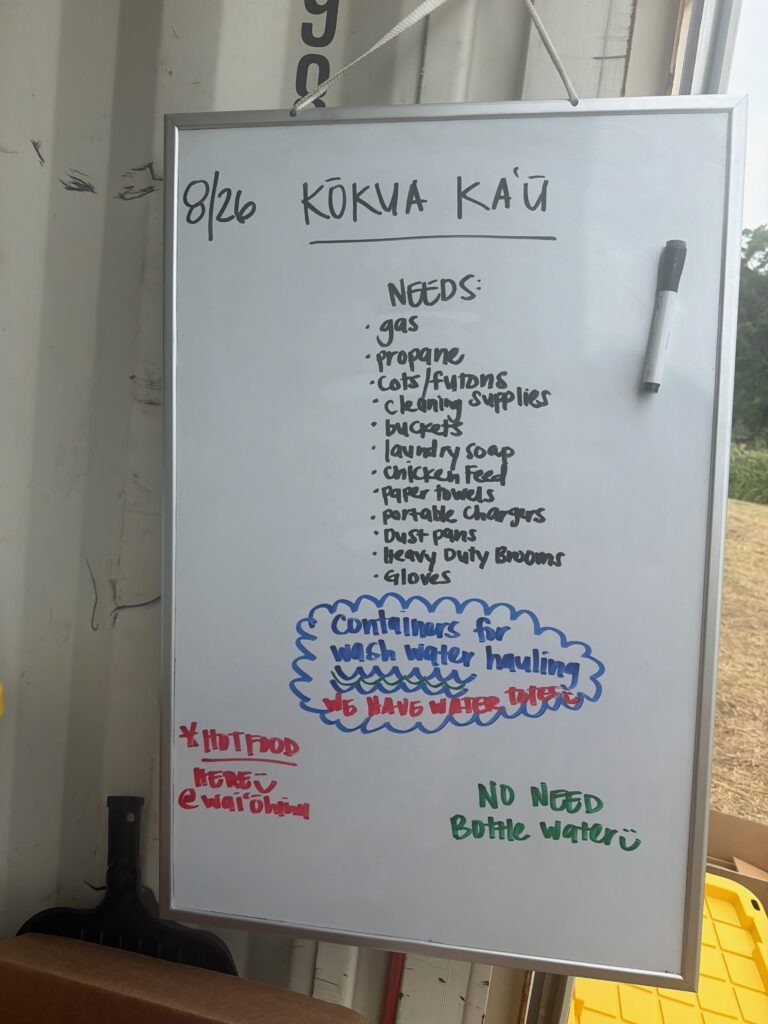
8/26/2026. Delivering items requested BY THE LOCALS. Not the other way around.
8/25/2026. Cooking hot meails for National Guard troops providing security after the hurricane.
8/25/2026. Why our NHO exists. To support the families in Ka'u.
What we need before the next one
Readiness is built between disasters, not during them. The most useful thing anyone can offer right now is capability we can pre position and call on the moment the highway closes.
In kind support we can use
Covered warehouse or container staging space inside the district
Four wheel drive trucks, trailers, and drivers who know Kaʻū roads
Portable power stations, generators, and fuel
Potable water, water storage, and filtration
Propane, camp stoves, and lighters
Non perishable food, including meals suited to kūpuna
Coolers, ice, batteries, tarps, and cleaning supplies
Satellite communications and two way radios
Licensed medical volunteers and first aid supplies
Freight, shipping, and inter island transport capacity
Offer support
Companies, agencies, and individuals who can contribute equipment, transport, storage, or professional capability can reach us through our contact form. Please include 30-Day Relief in your message so it routes to the right people, and tell us what you can provide and where it is located.
Mālama Kaʻū Foundation is a Native Hawaiian Organization and a 501(c)(3) public charity, EIN 87-4142178.
Contact us about 30-Day ReliefKaʻū will not wait thirty days alone.
Mālama Kaʻū Foundation, Inc. is a Native Hawaiian Organization and a 501(c)(3) public charity. Our 30-Day Disaster Relief effort complements, and does not replace, the response provided by the County of Hawaiʻi, the State of Hawaiʻi, and the Federal government.